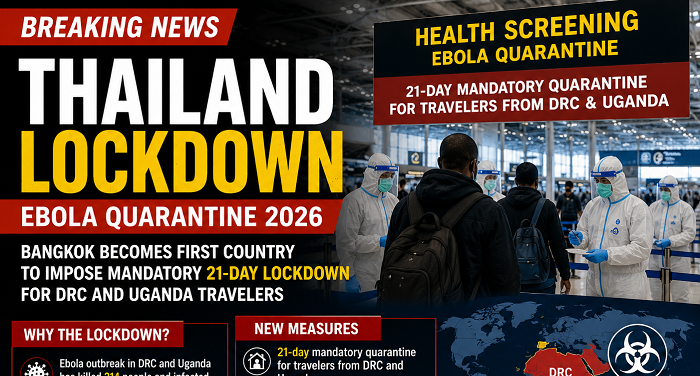
Thailand has become the first country to impose a mandatory 21-day quarantine for travelers arriving from or transiting through the Democratic Republic of Congo (DRC) and Uganda amid growing international concern over a worsening Ebola outbreak in Central and East Africa.
According to Thailand’s Ministry of Public Health, the emergency measures officially took effect Tuesday evening, May 26, 2026, following approval by the country’s National Communicable Disease Committee. Officials confirmed that all travelers entering Thailand from affected regions will now undergo strict health monitoring and quarantine procedures designed to prevent the virus from spreading into the country.
Under the new rules, travelers without symptoms will be required to quarantine at designated facilities for at least 21 days, while anyone displaying possible Ebola symptoms will be isolated in specialized state hospitals. Authorities also announced that arrivals from affected African regions would be routed through Bangkok’s Suvarnabhumi Airport for enhanced screening and monitoring.
The emergency response comes as the World Health Organization continues warning about the rapidly escalating Ebola outbreak centered in the eastern DRC. Reports indicate the outbreak has resulted in more than 200 deaths and hundreds of suspected cases, with Uganda also confirming infections linked to the crisis.
Reuters reported that several nations, including Canada, the Bahamas, Uganda, Mexico, and the United States, have also implemented new border controls, travel restrictions, airport screenings, or quarantine measures in response to the outbreak.
Thailand’s Health Ministry stated that the country had not yet identified Ebola-positive travelers within its borders but emphasized that international travel patterns and global movement created elevated risks requiring immediate preventive action.
Global health officials continue expressing concern about the Bundibugyo strain involved in the outbreak, noting that no fully approved vaccine currently exists for that strain. The World Health Organization has classified the situation as a major international public health emergency as containment efforts continue across affected regions.